
What a Chimney Cap Does
A chimney cap is a metal cover that sits on top of your flue opening. It’s one of the cheapest components on your chimney and one of the most important. Without it, your flue is an open hole in your roof. Rain, snow, and hail fall directly in. Birds, squirrels, and raccoons nest inside. Leaves and debris accumulate and create blockages. Downdrafts blow cold air and sometimes sparks back into your home.
A properly fitted cap solves all of these problems. The solid top sheds precipitation. The mesh screen keeps animals and debris out while still allowing combustion gases to vent. A built-in spark arrestor prevents burning embers from landing on your roof or nearby trees. And the cap’s design reduces downdraft by disrupting wind patterns at the flue opening.
It’s the kind of component that costs relatively little to install and saves thousands in damage when it’s doing its job.
Why Denver Chimneys Need a Cap
Denver’s climate makes the case for chimney caps better than we ever could. Front Range weather throws everything at your chimney with heavy spring rain, summer hailstorms, early fall snow, and the constant freeze-thaw cycle that damages any moisture trapped inside the flue.
Without a cap, every rainstorm sends water directly down your flue. That water soaks into the clay tile liner, saturates mortar joints, rusts the damper, and pools in the smoke shelf. In a climate with 100+ freeze-thaw cycles per year, every drop of that water becomes a tiny demolition crew. The damage is slow and invisible until it’s expensive.
Wildlife is the other issue. Denver’s urban-wildlife interface means raccoons, squirrels, and birds routinely nest in uncapped chimneys. A raccoon nest blocks your flue and creates a carbon monoxide hazard. Removing the animal, clearing the nest, and cleaning the flue costs far more than installing a cap that prevents the problem entirely. [Link to /animal-removal/]
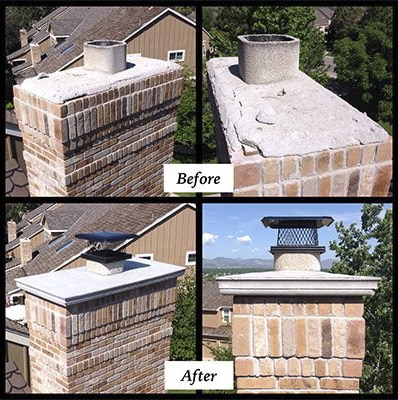
Types of Chimney Caps We Install
Single-Flue Caps
The standard cap for chimneys with one flue tile. A metal top plate covers the flue opening, mesh screening wraps the sides, and mounting hardware secures the cap to the flue tile. We measure the flue on-site and fit a cap that matches the exact dimensions. A cap that’s too small leaves gaps. A cap that’s too large sits loose and eventually blows off in Colorado’s high winds.
Multi-Flue Caps (Full-Cover Caps)
For chimneys with two or more flue tiles, a full-cover cap spans the entire chimney crown with individual screened openings for each flue. These caps also protect the crown itself from direct rain and UV exposure, extending the crown’s lifespan significantly. We custom-size full-cover caps to match the chimney’s footprint.
Top-Mount Damper Caps
A combination cap and damper that mounts on top of the flue and replaces the traditional throat damper inside the firebox. When closed, it seals the flue completely, much tighter than an old throat damper and preventing heat loss, downdrafts, and animal entry. When open, it functions as a standard cap with spark arrestor. We install these as both new installations and replacements for failed throat dampers.
Materials
We install stainless steel and copper caps. Stainless steel is the workhorse, durable, rust-resistant, and cost-effective. Copper caps are more expensive but develop a natural patina over time and can complement the look of higher-end homes. We don’t install galvanized steel caps. They’re cheaper upfront but rust through in Denver’s climate within a few years, which means you’re paying for installation twice.

Signs Your Chimney Cap Needs Attention
A cap that’s rusted through, dented from hail, or missing entirely is obvious. But some failures are subtler. Mesh screening can corrode and develop holes large enough for birds to enter. Mounting hardware loosens over time, especially in high-wind areas. Caps can shift position after a storm without being visibly damaged, leaving one side of the flue exposed. If you’ve had a significant hailstorm or windstorm and haven’t checked the cap, it’s worth having it looked at during your annual inspection.
Frequently Asked Questions About Chimney Caps
It depends on the type, material, and whether it’s a standard size or custom fit. Single-flue stainless steel caps are the most affordable. Full-cover multi-flue caps and copper caps cost more. We provide pricing after measuring your flue on-site.
You can, but we don’t recommend it. Getting the sizing wrong leaves gaps that defeat the purpose. Working on a roof carries fall risk. And improper installation can block the flue or create a fire hazard if the cap interferes with venting. A professional installation takes about 30 minutes and lasts for years.
A quality stainless steel cap lasts 15-20+ years in Denver’s climate. Copper caps last even longer. Galvanized steel caps typically rust through in 3-5 years along the Front Range, which is why we don’t install them.
A properly sized cap does not restrict draft. In fact, certain cap designs improve draft by disrupting wind patterns that cause downdraft. If you’re experiencing draft problems after a cap installation, the cap may be undersized or improperly positioned so just bring us out and we’ll evaluate it.
Yes. Gas fireplaces still vent through a flue, and that flue is still susceptible to rain, animal entry, and debris. The cap type may differ from a wood-burning setup, but the protection is just as necessary.
We remove the animals safely first, clean and inspect the flue, then install a cap to prevent re-entry. Don’t install a cap over an occupied flue — you’ll trap the animals inside and create a much bigger problem.
Chimney Cap Related Services
-
Animal Removal — Safe removal of wildlife from chimneys and attics
-
Chimney Inspections — Annual condition reports including cap evaluation
-
Masonry Repairs — Crown repair, tuckpointing, and waterproofing
-
Chimney Repairs— Liner, structural, and full-system chimney work
Proudly serving Denver, Wheat Ridge, Lakewood, Arvada, Golden, Boulder, Littleton, Englewood, Aurora, Westminster, Centennial, Parker, and all of metro Denver.